The Mineral Network won the competition in Nome!
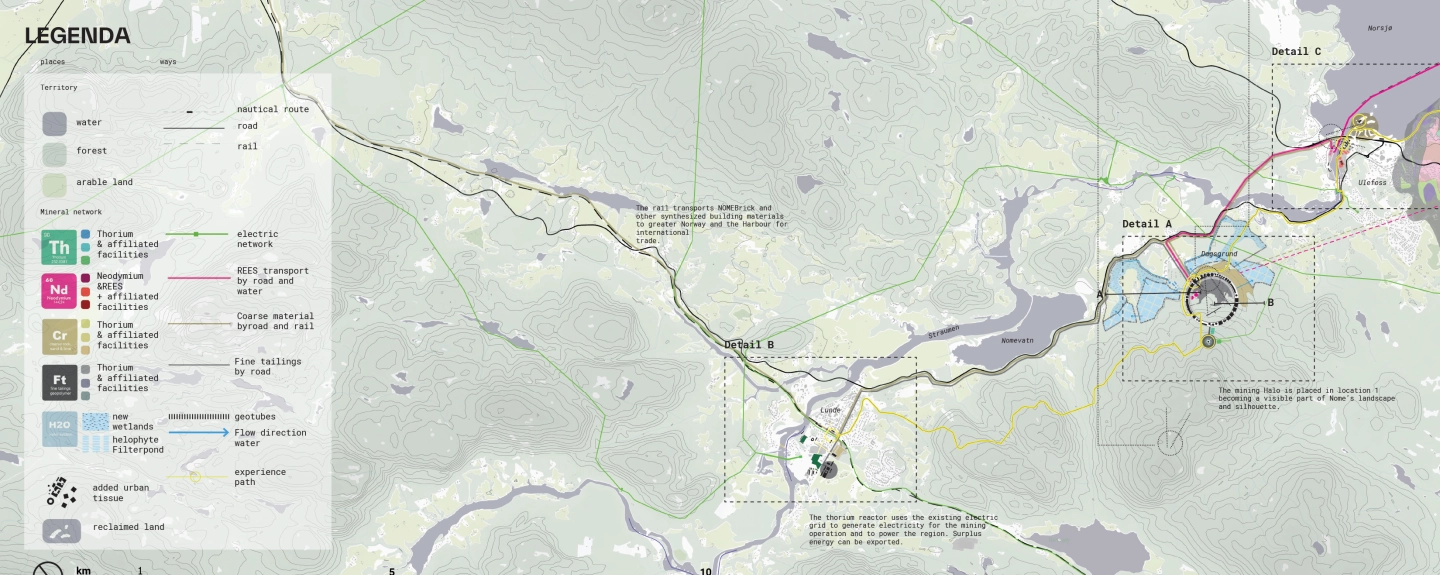
The project The Mineral Network by Giacomo Gallo, Robert Thomas Younger, Tadej Gregorič, Bregje Lidewij Walkate, Maarten Johannes Filius, Remco Alexander van der Togt and Karlijn Simone Besse won the competition in Nome!
General Remarks by the jury
Across the competition entries, the jury observed a remarkable breadth of approaches to the question of how mining can coexist with ecological, social, and spatial systems. The submissions reveal an evolving understanding of extraction as more than an industrial process, and many teams approached it as a cultural, territorial, and environmental condition. This shift signals a new architectural consciousness, where mining is not only a question of infrastructure but also of stewardship, adaptation, and long-term landscape care.
A common strength among the strongest entries lies in their ability to frame mining within a larger regional narrative. Rather than focusing solely on the site of extraction, several projects interpreted the task as an opportunity to redefine relationships between settlements, transport infrastructure, and the natural environment. This territorial approach was complemented by an increasing awareness of temporal depth: the best proposals considered both the operational lifespan of the mine and the uncertain futures beyond it. Time was treated as an architectural material, something to be shaped, structured, and narrated.
The jury also notes a clear tendency toward integration between ecological and industrial systems. The re-use of tailings, surplus masses, and byproducts was frequently explored as a means to restore or even enhance the environment. This reflects a growing understanding of design as a process of circular transformation rather than linear consumption. Such strategies exemplify a move away from remediation as an afterthought and toward regenerative design as an embedded principle.
At the same time, the jury observed a divide between analytical and propositional work. Some teams demonstrated outstanding analytical skills, producing precise mappings and environmental readings, yet stopped short of translating these insights into spatial or architectural form. Others ventured bold architectural statements but struggled to ground their visions in feasible or context-sensitive strategies. The most successful projects managed to balance these two modes: combining conceptual clarity with operable, site-specific thinking.
Finally, the jury was impressed by the visual and narrative quality of the presentations. Many entries demonstrated a high level of graphic and conceptual literacy, using drawings as both analytical and speculative tools. The overall standard of representation was exceptionally high, revealing a generation of designers who think across scales and disciplines.
The competition as a whole reflects a significant moment in architectural thinking—one in which extraction is reimagined as an open, collaborative, and visible process, capable of shaping new forms of coexistence between human activity and the landscape.
Nome is a preparedness project that goes straight into world politics. Europe must make itself independent of the other continents and superpowers when it comes to rare earth minerals. It will be especially important not to be dependent on China, which supports Russia in its war against Ukraine, and indirectly us.
The competition and resulting entries are playing a crucial role in equipping the municipality with guidelines and rules, even knowledge of what a potential mining operation can be and become. Nome already has a long history of industry and mining, with Ulefoss Jernverk being one of Europe’s oldest operating companies. The REE mine and industrial park can continue, and build on this proud history; however is also a project of a whole different scale and magnitude. The proposals offer Nome a valuable spectrum of possible futures, ranging from bold non-intervention to regenerative integration, thus serving as an essential, proactive tool for informed decision-making regardless of the ultimate outcome.
Download the full report for feedback on projects
Winner: The Mineral Network


Team
Giacomo Gallo (IT), architect
Robert Thomas Younger (DE), urban planner
Tadej Gregorič (SI), student in urban planning
Bregje Lidewij Walkate (NL), architect
Maarten Johannes Filius (NL), architect
Remco Alexander van der Togt (NL), landscape architect
Karlijn Simone Besse (NL), architect
Jury remarks
The jury finds this to be a comprehensive and ambitious proposal that engages seriously with the future of mining in the Nome region. The project demonstrates a clear and confident territorial strategy, positioning the mining industry not as a hidden or environmentally stigmatized activity, but as an integral and even celebrated part of the regional identity. By proposing a monumental architectural structure that showcases the local resources above ground, the team redefines the cultural role of extraction and frames it as a civic and educational experience. This is a courageous and forward-looking gesture, signaling a new paradigm in how industrial landscapes may be understood and designed.
The plan is visually clear and didactic, presenting the Norsj-Frierfjorden axis across the entire width of the presentation. The mapping of extraction, transport, and logistics is both precise and visionary, envisioning a future network of new rail and port connections that integrate local resources into wider national and international systems. The jury particularly appreciates how the proposal strengthens existing towns such as Ulefoss and Lunde through urban and infrastructural measures, thereby linking industrial development to social and spatial renewal.
A central strength of the project lies in its treatment of industrial byproducts. The proposal integrates the tailings and surplus masses directly into the architectural and ecological fabric of the site. Containing the tailings within a visible structure—allowing its volume to change with production—offers a powerful visual and spatial expression of industrial temporality. Furthermore, the reuse of excess materials to restore wetlands and improve local ecologies demonstrates a holistic and responsible approach to landscape transformation. The project thereby redefines extraction as an ongoing environmental process rather than a purely economic operation.
The jury commends the strong narrative and exceptional graphic presentation. The visual material communicates a complex and multifaceted issue with great clarity and conviction. The architecture adapts elegantly to the topography, while the visual language and storytelling bring coherence and depth to the proposal. The presentation effectively bridges technical precision and artistic imagination.
Nevertheless, the jury also identifies several points of concern. The infrastructural ambitions, such as the proposed new railway and port facilities, raise significant questions regarding feasibility and environmental impact. The jury doubts whether the existing, protected locks of the UNESCO-listed canal system can withstand modern industrial transport, and is skeptical about the proposal to sacrifice the bay and local community in Flakvarpbukta, especially when alternative industrial sites already exist nearby, such as Herøya, Skien Harbor Terminal, and Rafnes.
Despite these reservations, the jury considers the project to be the most complete and conceptually coherent submissions. It demonstrates a rare capacity to connect architecture, infrastructure, and ecology within a single, long-term vision. The proposal inspires confidence by taking the entire region seriously, spatially, environmentally, and politically, and offers a strong foundation for further work. It stands as an exemplary contribution to the ongoing dialogue on how architecture can redefine the relationship between resource extraction, landscape, and society.
Special Mention: A 100 years playbook
Team
Alberto Roncelli (DK), architect
Nicole Vettore (IT), architect
Jury remarks
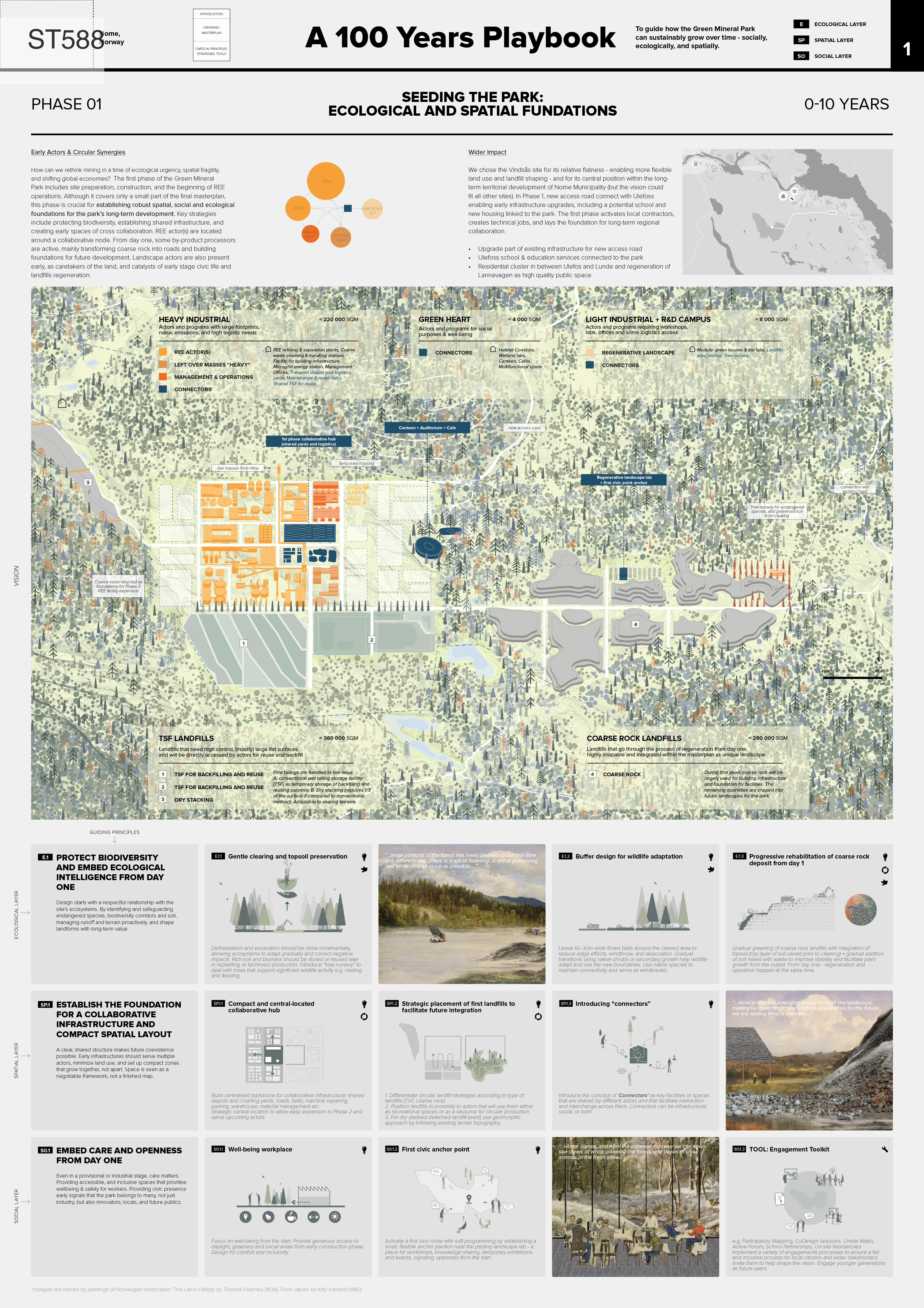
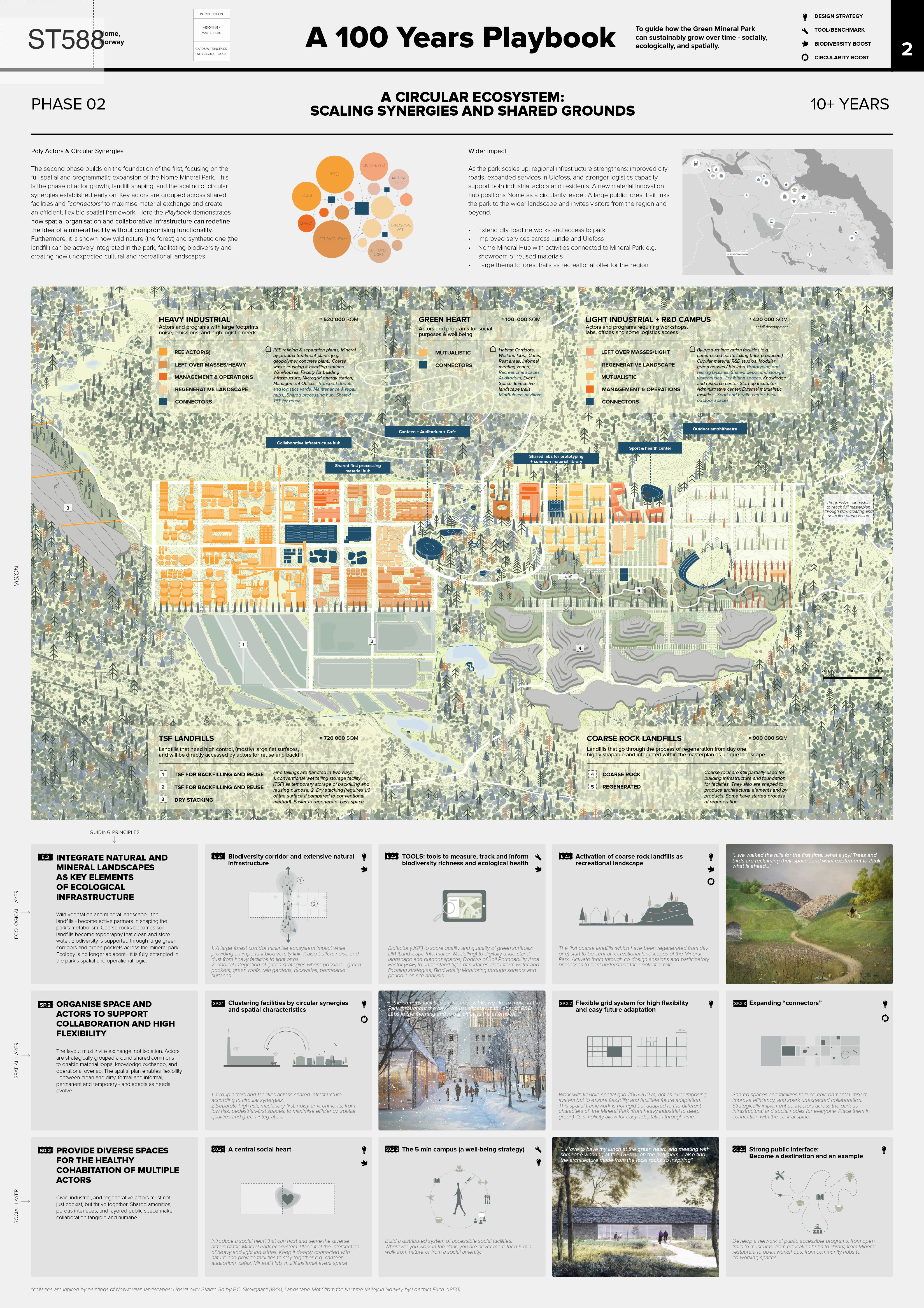
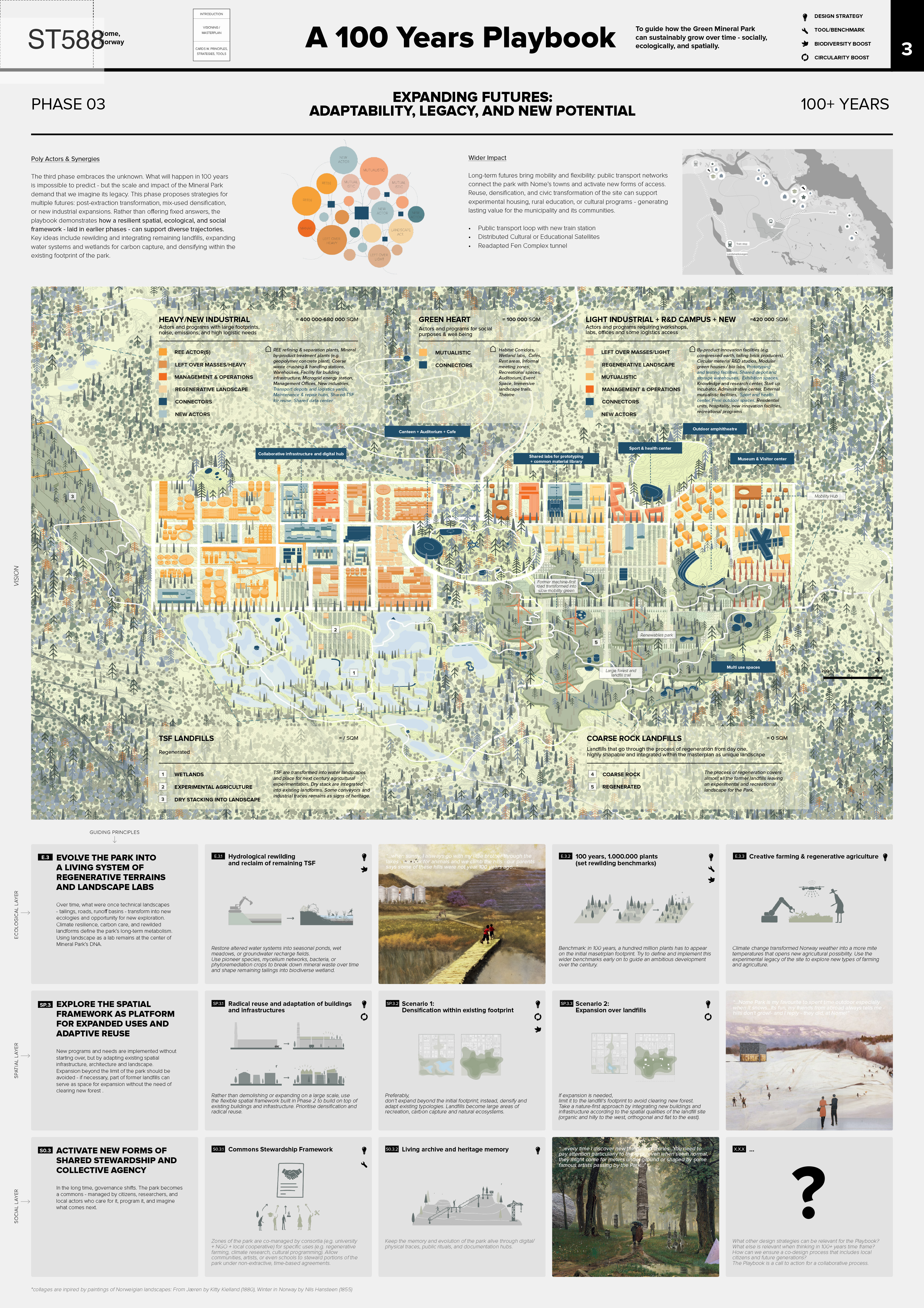
The proposal deals beautifully with the challenge that lies ahead: how to plan for uncertain situations in a way that secures a green mineral park over a 100 year time frame. The proposal A 100 years playbook is a handbook and a planning tool that responds to the complexity of planning for a completely unknown future. From laying the groundwork for an ecological foundation for the mineral park in the first 10 years, to principles for imagining post-extraction transformations in a completely unknown future in 100+ years. A 100 years playbook provides a framework and clear guidelines challenging the actors to collaborate, plan, and think about synergies with others, whilst promising a system of step-by-step landscape generation.
As the proposal is more of a strategy for a project, illustrations are diagrammatic, which is both a strength and a weakness. The strategy becomes clear and visual; at the same time, there are no landscape studies or site analysis, and no concrete site proposal. The illustrations do not completely fit the diagrams and text. The understanding of the components and complexity going into a mine has been addressed in an important way and is commendable.
A 100 year playbook is a thorough tactic and a strategy of operations. It moves the general approach from a purely extraction perspective to a process where thoughtfulness about ecological, social, and spatial aspects becomes ingrained in every process, every actor, and every step forward for a green mineral park.
Special Mention: "green mineral park"
Team
Mehmet Derin Incekas (TR), architect
Pelin Gezer (TR), architect
Jury remarks
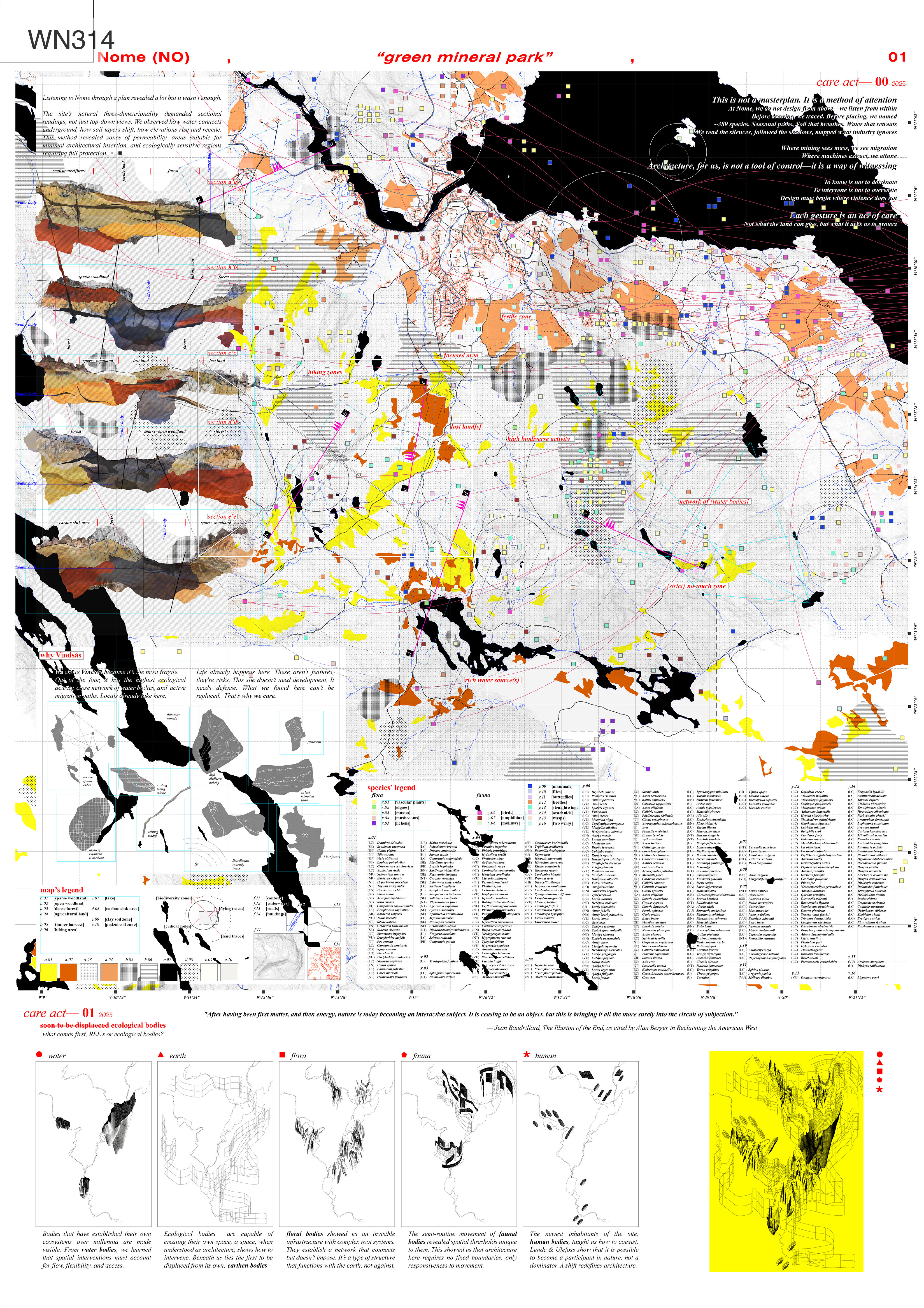
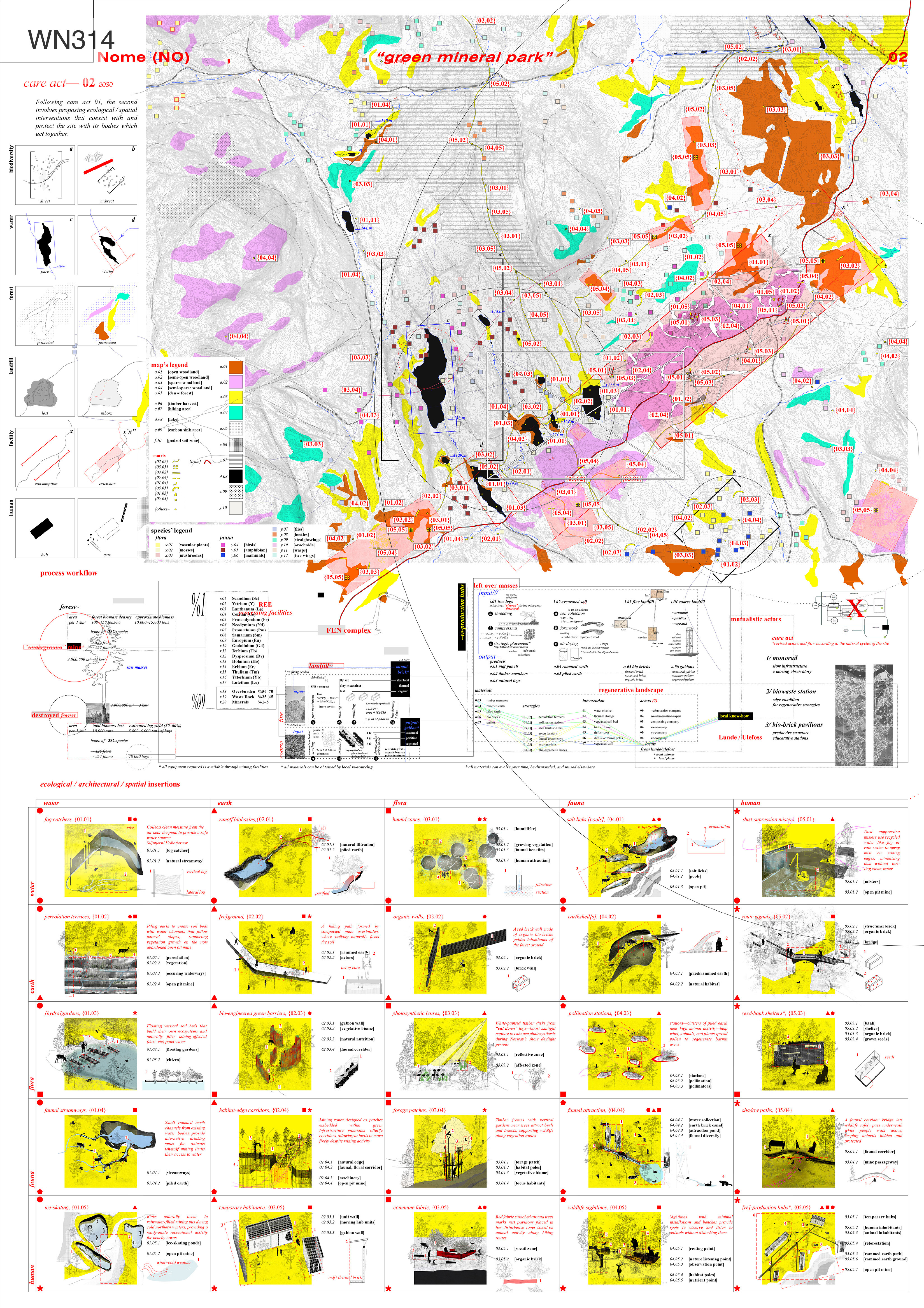
The proposal demonstrates a meticulous and extensive mapping of existing conditions, revealing a strong capacity for spatial observation and analytical precision. The representation of the site’s ecological and material layers is both comprehensive and visually refined. However, despite the sophistication of this cartographic work, the project fails to move beyond analysis. The mapping remains an end in itself rather than a foundation for spatial or strategic development. As a result, the proposal does not respond to the client’s brief, nor does it engage with the central issue of mining that defines the task.
Instead, the proposal delivers a powerful statement—a compelling argument for not moving ahead with the mining plans. This stand is both brave and bold, grounded in a standpoint of ethical responsibility and environmental stewardship. In doing so, it effectively makes visible and gives a voice to the many diverse inhabitants who would be sequentially and differently affected by a mine in Nome.
On the other hand, the absence of an operative or design response exposes a fundamental gap between investigation and proposition. While the mapping uncovers valuable insights, these are never translated into an architectural or territorial strategy capable of addressing the realities and responsibilities of extraction. The project instead takes refuge in its analytical stance, positioning itself as a critical commentary rather than a design solution. This can be interpreted as an intentional act of resistance, but in doing so, the team neglects the essential demand of the assignment: to propose.
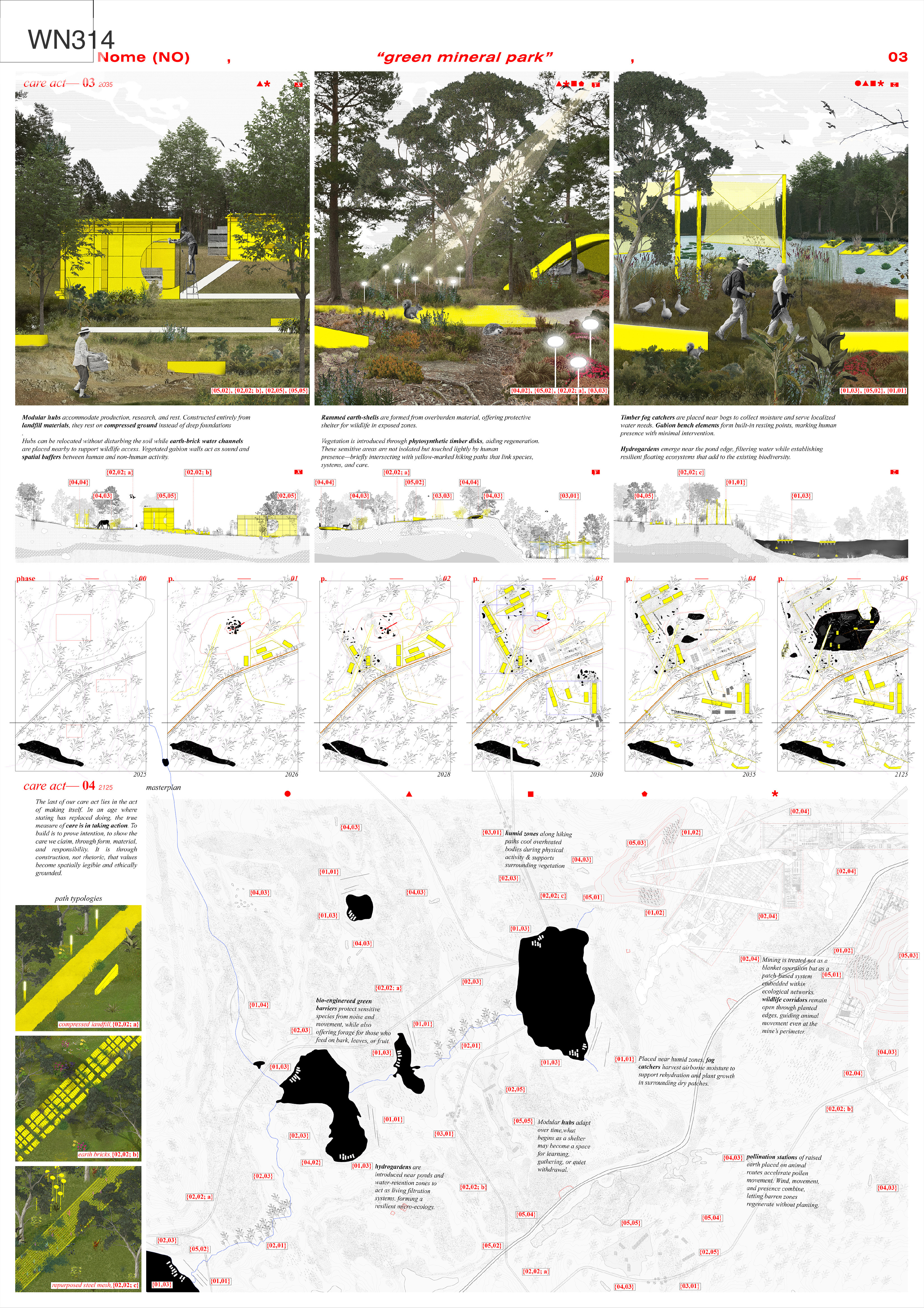
From an architectural perspective, the work therefore risks intellectual isolation. Its conceptual statement is undermined by a lack of engagement with spatial transformation or material consequence. What could have been a powerful synthesis of critique and design instead remains incomplete—strong in observation but ultimately unable to answer the question it set out to confront.